Simulation Study Example: Assessing Model Performance
Source:vignettes/simulation-study.Rmd
simulation-study.Rmd
library(bayesim)
library(dplyr)
#>
#> Attaching package: 'dplyr'
#> The following object is masked from 'package:bayesim':
#>
#>     compute
#> The following objects are masked from 'package:stats':
#>
#>     filter, lag
#> The following objects are masked from 'package:base':
#>
#>     intersect, setdiff, setequal, union
library(ggplot2)
#>
#> Attaching package: 'ggplot2'
#> The following object is masked from 'package:bayesim':
#>
#>     %+%
Introduction
Simulation studies help us understand how statistical models perform under controlled conditions. By systematically varying data characteristics and measuring estimation accuracy, we identify scenarios where models excel or struggle. This vignette demonstrates how to conduct a simulation study using bayesim.
This example assesses how sample size and noise level affect parameter estimation accuracy in a simple linear regression model. We generate synthetic data with known parameters, fit models to each dataset, and compute metrics that quantify estimation quality. This pattern applies to more complex models and study designs.
bayesim provides a structured framework for such studies with three components: (1) a data generator function that creates synthetic datasets, (2) a configuration object that defines the simulation grid and settings, and (3) a runner that executes the study with deterministic reproducibility.
Study Design
This study examines two factors that affect model performance:
- Sample size (n): We test n = 50, 100, 200, and 500 observations. Larger samples should yield more precise estimates.
- Noise level (sigma): We test sigma = 0.5, 1, and 2. Higher noise makes estimation more challenging.
The full factorial design yields 4 × 3 = 12 data generation conditions. For each condition, we run 20 replicates with different random seeds, giving 240 total simulation tasks.
We assess performance using four metrics:
- RMSE: Root mean square error of predictions
- Bias: Mean bias of predictions
- Coverage: Whether true parameters fall within 95% credible intervals
- Posterior Mean: Estimated parameter values for tracking estimation accuracy
Data Generator
The data generator creates synthetic linear regression data. It must
have the signature (data_spec, seed, task_ctx):
generate_linear_data <- function(data_spec, seed, task_ctx) {
  # Note: seed is a scalar task seed.
  # The simulation engine also restores the task RNG stream before each call.
  # so you typically don't need to call set.seed() here.
  # If you need additional randomization, the state is already set correctly.
  n <- data_spec$n
  intercept <- data_spec$intercept
  slope <- data_spec$slope
  sigma <- data_spec$sigma

  # Generate predictor and response
  x <- rnorm(n, mean = 0, sd = 1)
  y <- intercept + slope * x + rnorm(n, mean = 0, sd = sigma)

  # Return data bundle with required components
  list(
    train = data.frame(y = y, x = x),
    test = NULL,
    response = "y",
    true_params = c(
      intercept = intercept,
      slope = slope,
      sigma = sigma
    ),
    vars_of_interest = c("intercept", "slope", "sigma"),
    references = c(intercept = 0, slope = 0, sigma = 1),
    meta = list()
  )
}
The data bundle must include:
-
train: Training data as a data frame -
test: Optional test data (NULL here since we evaluate on training data) -
response: Name of the response variable -
true_params: Named vector of true parameter values for coverage calculations -
vars_of_interest: Parameters to track in metrics -
references: Reference values for certain metrics -
meta: Optional metadata
Configuration
We create a simulation configuration that combines the data grid, fit grid, and execution settings:
config <- simulation_config(
  data_grid = data.frame(
    n = c(50, 100, 200, 500),
    intercept = 1.0,
    slope = 2.0,
    sigma = rep(c(0.5, 1, 2), each = 4)
  ),
  fit_grid = data.frame(
    model = "linear_regression"
  ),
  data_generator = generate_linear_data,
  fitter = MockFitter(),
  metrics = list(
    rmse_metric(),
    bias_metric(),
    coverage_metric(),
    posterior_mean_metric()
  ),
  n_replicates = 20L,
  seed = 42L
)
We use MockFitter() here for illustration. For actual
Bayesian models, use BrmsFitter() or a custom fitter that
interfaces with your modeling backend. The MockFitter simulates
realistic output structure without requiring brms or Stan to be
installed, making this vignette self-contained and fast to run.
The data_grid specifies all combinations of sample size
and noise level. The fit_grid contains a single model
specification since we compare data conditions rather than model
variants. The metrics list includes objects (not character strings) that
define what to compute for each simulation replicate. Built-in metric
constructors like rmse_metric() have default names; custom
metrics require an explicit name argument.
Running the Simulation
Execute the simulation with progress display:
result <- run_simulation(config, progress = TRUE)
#> ℹ Starting simulation with 240 tasks
#> Warning in draws[, slope_param] * x: longer object length is not a multiple of
#> shorter object length
#> Warning in draws[, intercept_param] + draws[, slope_param] * x: longer object
#> length is not a multiple of shorter object length
#> Warning in matrix(rep(predicted_mean, each = n_obs), nrow = n_obs, ncol =
#> n_draws): data length differs from size of matrix: [250000 != 500 x 400]
#> Warning in draws[, slope_param] * x: longer object length is not a multiple of
#> shorter object length
#> Warning in draws[, intercept_param] + draws[, slope_param] * x: longer object
#> length is not a multiple of shorter object length
#> Warning in matrix(rep(predicted_mean, each = n_obs), nrow = n_obs, ncol =
#> n_draws): data length differs from size of matrix: [250000 != 500 x 400]
#> Warning in draws[, slope_param] * x: longer object length is not a multiple of
#> shorter object length
#> Warning in draws[, intercept_param] + draws[, slope_param] * x: longer object
#> length is not a multiple of shorter object length
#> Warning in matrix(rep(predicted_mean, each = n_obs), nrow = n_obs, ncol =
#> n_draws): data length differs from size of matrix: [250000 != 500 x 400]
#> Warning in draws[, slope_param] * x: longer object length is not a multiple of
#> shorter object length
#> Warning in draws[, intercept_param] + draws[, slope_param] * x: longer object
#> length is not a multiple of shorter object length
#> Warning in matrix(rep(predicted_mean, each = n_obs), nrow = n_obs, ncol =
#> n_draws): data length differs from size of matrix: [250000 != 500 x 400]
#> Warning in draws[, slope_param] * x: longer object length is not a multiple of
#> shorter object length
#> Warning in draws[, intercept_param] + draws[, slope_param] * x: longer object
#> length is not a multiple of shorter object length
#> Warning in matrix(rep(predicted_mean, each = n_obs), nrow = n_obs, ncol =
#> n_draws): data length differs from size of matrix: [250000 != 500 x 400]
#> Warning in draws[, slope_param] * x: longer object length is not a multiple of
#> shorter object length
#> Warning in draws[, intercept_param] + draws[, slope_param] * x: longer object
#> length is not a multiple of shorter object length
#> Warning in matrix(rep(predicted_mean, each = n_obs), nrow = n_obs, ncol =
#> n_draws): data length differs from size of matrix: [250000 != 500 x 400]
#> Warning in draws[, slope_param] * x: longer object length is not a multiple of
#> shorter object length
#> Warning in draws[, intercept_param] + draws[, slope_param] * x: longer object
#> length is not a multiple of shorter object length
#> Warning in matrix(rep(predicted_mean, each = n_obs), nrow = n_obs, ncol =
#> n_draws): data length differs from size of matrix: [250000 != 500 x 400]
#> Warning in draws[, slope_param] * x: longer object length is not a multiple of
#> shorter object length
#> Warning in draws[, intercept_param] + draws[, slope_param] * x: longer object
#> length is not a multiple of shorter object length
#> Warning in matrix(rep(predicted_mean, each = n_obs), nrow = n_obs, ncol =
#> n_draws): data length differs from size of matrix: [250000 != 500 x 400]
#> Warning in draws[, slope_param] * x: longer object length is not a multiple of
#> shorter object length
#> Warning in draws[, intercept_param] + draws[, slope_param] * x: longer object
#> length is not a multiple of shorter object length
#> Warning in matrix(rep(predicted_mean, each = n_obs), nrow = n_obs, ncol =
#> n_draws): data length differs from size of matrix: [250000 != 500 x 400]
#> Warning in draws[, slope_param] * x: longer object length is not a multiple of
#> shorter object length
#> Warning in draws[, intercept_param] + draws[, slope_param] * x: longer object
#> length is not a multiple of shorter object length
#> Warning in matrix(rep(predicted_mean, each = n_obs), nrow = n_obs, ncol =
#> n_draws): data length differs from size of matrix: [250000 != 500 x 400]
#> Warning in draws[, slope_param] * x: longer object length is not a multiple of
#> shorter object length
#> Warning in draws[, intercept_param] + draws[, slope_param] * x: longer object
#> length is not a multiple of shorter object length
#> Warning in matrix(rep(predicted_mean, each = n_obs), nrow = n_obs, ncol =
#> n_draws): data length differs from size of matrix: [250000 != 500 x 400]
#> Warning in draws[, slope_param] * x: longer object length is not a multiple of
#> shorter object length
#> Warning in draws[, intercept_param] + draws[, slope_param] * x: longer object
#> length is not a multiple of shorter object length
#> Warning in matrix(rep(predicted_mean, each = n_obs), nrow = n_obs, ncol =
#> n_draws): data length differs from size of matrix: [250000 != 500 x 400]
#> Warning in draws[, slope_param] * x: longer object length is not a multiple of
#> shorter object length
#> Warning in draws[, intercept_param] + draws[, slope_param] * x: longer object
#> length is not a multiple of shorter object length
#> Warning in matrix(rep(predicted_mean, each = n_obs), nrow = n_obs, ncol =
#> n_draws): data length differs from size of matrix: [250000 != 500 x 400]
#> Warning in draws[, slope_param] * x: longer object length is not a multiple of
#> shorter object length
#> Warning in draws[, intercept_param] + draws[, slope_param] * x: longer object
#> length is not a multiple of shorter object length
#> Warning in matrix(rep(predicted_mean, each = n_obs), nrow = n_obs, ncol =
#> n_draws): data length differs from size of matrix: [250000 != 500 x 400]
#> Warning in draws[, slope_param] * x: longer object length is not a multiple of
#> shorter object length
#> Warning in draws[, intercept_param] + draws[, slope_param] * x: longer object
#> length is not a multiple of shorter object length
#> Warning in matrix(rep(predicted_mean, each = n_obs), nrow = n_obs, ncol =
#> n_draws): data length differs from size of matrix: [250000 != 500 x 400]
#> Warning in draws[, slope_param] * x: longer object length is not a multiple of
#> shorter object length
#> Warning in draws[, intercept_param] + draws[, slope_param] * x: longer object
#> length is not a multiple of shorter object length
#> Warning in matrix(rep(predicted_mean, each = n_obs), nrow = n_obs, ncol =
#> n_draws): data length differs from size of matrix: [250000 != 500 x 400]
#> Warning in draws[, slope_param] * x: longer object length is not a multiple of
#> shorter object length
#> Warning in draws[, intercept_param] + draws[, slope_param] * x: longer object
#> length is not a multiple of shorter object length
#> Warning in matrix(rep(predicted_mean, each = n_obs), nrow = n_obs, ncol =
#> n_draws): data length differs from size of matrix: [250000 != 500 x 400]
#> Warning in draws[, slope_param] * x: longer object length is not a multiple of
#> shorter object length
#> Warning in draws[, intercept_param] + draws[, slope_param] * x: longer object
#> length is not a multiple of shorter object length
#> Warning in matrix(rep(predicted_mean, each = n_obs), nrow = n_obs, ncol =
#> n_draws): data length differs from size of matrix: [250000 != 500 x 400]
#> Warning in draws[, slope_param] * x: longer object length is not a multiple of
#> shorter object length
#> Warning in draws[, intercept_param] + draws[, slope_param] * x: longer object
#> length is not a multiple of shorter object length
#> Warning in matrix(rep(predicted_mean, each = n_obs), nrow = n_obs, ncol =
#> n_draws): data length differs from size of matrix: [250000 != 500 x 400]
#> Warning in draws[, slope_param] * x: longer object length is not a multiple of
#> shorter object length
#> Warning in draws[, intercept_param] + draws[, slope_param] * x: longer object
#> length is not a multiple of shorter object length
#> Warning in matrix(rep(predicted_mean, each = n_obs), nrow = n_obs, ncol =
#> n_draws): data length differs from size of matrix: [250000 != 500 x 400]
#> Running tasks 51/240 [1.4s]
#> Warning in draws[, slope_param] * x: longer object length is not a multiple of
#> shorter object length
#> Warning in draws[, intercept_param] + draws[, slope_param] * x: longer object
#> length is not a multiple of shorter object length
#> Warning in matrix(rep(predicted_mean, each = n_obs), nrow = n_obs, ncol =
#> n_draws): data length differs from size of matrix: [250000 != 500 x 400]
#> Warning in draws[, slope_param] * x: longer object length is not a multiple of
#> shorter object length
#> Warning in draws[, intercept_param] + draws[, slope_param] * x: longer object
#> length is not a multiple of shorter object length
#> Warning in matrix(rep(predicted_mean, each = n_obs), nrow = n_obs, ncol =
#> n_draws): data length differs from size of matrix: [250000 != 500 x 400]
#> Warning in draws[, slope_param] * x: longer object length is not a multiple of
#> shorter object length
#> Warning in draws[, intercept_param] + draws[, slope_param] * x: longer object
#> length is not a multiple of shorter object length
#> Warning in matrix(rep(predicted_mean, each = n_obs), nrow = n_obs, ncol =
#> n_draws): data length differs from size of matrix: [250000 != 500 x 400]
#> Warning in draws[, slope_param] * x: longer object length is not a multiple of
#> shorter object length
#> Warning in draws[, intercept_param] + draws[, slope_param] * x: longer object
#> length is not a multiple of shorter object length
#> Warning in matrix(rep(predicted_mean, each = n_obs), nrow = n_obs, ncol =
#> n_draws): data length differs from size of matrix: [250000 != 500 x 400]
#> Warning in draws[, slope_param] * x: longer object length is not a multiple of
#> shorter object length
#> Warning in draws[, intercept_param] + draws[, slope_param] * x: longer object
#> length is not a multiple of shorter object length
#> Warning in matrix(rep(predicted_mean, each = n_obs), nrow = n_obs, ncol =
#> n_draws): data length differs from size of matrix: [250000 != 500 x 400]
#> Warning in draws[, slope_param] * x: longer object length is not a multiple of
#> shorter object length
#> Warning in draws[, intercept_param] + draws[, slope_param] * x: longer object
#> length is not a multiple of shorter object length
#> Warning in matrix(rep(predicted_mean, each = n_obs), nrow = n_obs, ncol =
#> n_draws): data length differs from size of matrix: [250000 != 500 x 400]
#> Warning in draws[, slope_param] * x: longer object length is not a multiple of
#> shorter object length
#> Warning in draws[, intercept_param] + draws[, slope_param] * x: longer object
#> length is not a multiple of shorter object length
#> Warning in matrix(rep(predicted_mean, each = n_obs), nrow = n_obs, ncol =
#> n_draws): data length differs from size of matrix: [250000 != 500 x 400]
#> Warning in draws[, slope_param] * x: longer object length is not a multiple of
#> shorter object length
#> Warning in draws[, intercept_param] + draws[, slope_param] * x: longer object
#> length is not a multiple of shorter object length
#> Warning in matrix(rep(predicted_mean, each = n_obs), nrow = n_obs, ncol =
#> n_draws): data length differs from size of matrix: [250000 != 500 x 400]
#> Warning in draws[, slope_param] * x: longer object length is not a multiple of
#> shorter object length
#> Warning in draws[, intercept_param] + draws[, slope_param] * x: longer object
#> length is not a multiple of shorter object length
#> Warning in matrix(rep(predicted_mean, each = n_obs), nrow = n_obs, ncol =
#> n_draws): data length differs from size of matrix: [250000 != 500 x 400]
#> Warning in draws[, slope_param] * x: longer object length is not a multiple of
#> shorter object length
#> Warning in draws[, intercept_param] + draws[, slope_param] * x: longer object
#> length is not a multiple of shorter object length
#> Warning in matrix(rep(predicted_mean, each = n_obs), nrow = n_obs, ncol =
#> n_draws): data length differs from size of matrix: [250000 != 500 x 400]
#> Running tasks 101/240 [2s]
#> Warning in draws[, slope_param] * x: longer object length is not a multiple of
#> shorter object length
#> Warning in draws[, intercept_param] + draws[, slope_param] * x: longer object
#> length is not a multiple of shorter object length
#> Warning in matrix(rep(predicted_mean, each = n_obs), nrow = n_obs, ncol =
#> n_draws): data length differs from size of matrix: [250000 != 500 x 400]
#> Warning in draws[, slope_param] * x: longer object length is not a multiple of
#> shorter object length
#> Warning in draws[, intercept_param] + draws[, slope_param] * x: longer object
#> length is not a multiple of shorter object length
#> Warning in matrix(rep(predicted_mean, each = n_obs), nrow = n_obs, ncol =
#> n_draws): data length differs from size of matrix: [250000 != 500 x 400]
#> Warning in draws[, slope_param] * x: longer object length is not a multiple of
#> shorter object length
#> Warning in draws[, intercept_param] + draws[, slope_param] * x: longer object
#> length is not a multiple of shorter object length
#> Warning in matrix(rep(predicted_mean, each = n_obs), nrow = n_obs, ncol =
#> n_draws): data length differs from size of matrix: [250000 != 500 x 400]
#> Warning in draws[, slope_param] * x: longer object length is not a multiple of
#> shorter object length
#> Warning in draws[, intercept_param] + draws[, slope_param] * x: longer object
#> length is not a multiple of shorter object length
#> Warning in matrix(rep(predicted_mean, each = n_obs), nrow = n_obs, ncol =
#> n_draws): data length differs from size of matrix: [250000 != 500 x 400]
#> Warning in draws[, slope_param] * x: longer object length is not a multiple of
#> shorter object length
#> Warning in draws[, intercept_param] + draws[, slope_param] * x: longer object
#> length is not a multiple of shorter object length
#> Warning in matrix(rep(predicted_mean, each = n_obs), nrow = n_obs, ncol =
#> n_draws): data length differs from size of matrix: [250000 != 500 x 400]
#> Warning in draws[, slope_param] * x: longer object length is not a multiple of
#> shorter object length
#> Warning in draws[, intercept_param] + draws[, slope_param] * x: longer object
#> length is not a multiple of shorter object length
#> Warning in matrix(rep(predicted_mean, each = n_obs), nrow = n_obs, ncol =
#> n_draws): data length differs from size of matrix: [250000 != 500 x 400]
#> Warning in draws[, slope_param] * x: longer object length is not a multiple of
#> shorter object length
#> Warning in draws[, intercept_param] + draws[, slope_param] * x: longer object
#> length is not a multiple of shorter object length
#> Warning in matrix(rep(predicted_mean, each = n_obs), nrow = n_obs, ncol =
#> n_draws): data length differs from size of matrix: [250000 != 500 x 400]
#> Warning in draws[, slope_param] * x: longer object length is not a multiple of
#> shorter object length
#> Warning in draws[, intercept_param] + draws[, slope_param] * x: longer object
#> length is not a multiple of shorter object length
#> Warning in matrix(rep(predicted_mean, each = n_obs), nrow = n_obs, ncol =
#> n_draws): data length differs from size of matrix: [250000 != 500 x 400]
#> Warning in draws[, slope_param] * x: longer object length is not a multiple of
#> shorter object length
#> Warning in draws[, intercept_param] + draws[, slope_param] * x: longer object
#> length is not a multiple of shorter object length
#> Warning in matrix(rep(predicted_mean, each = n_obs), nrow = n_obs, ncol =
#> n_draws): data length differs from size of matrix: [250000 != 500 x 400]
#> Warning in draws[, slope_param] * x: longer object length is not a multiple of
#> shorter object length
#> Warning in draws[, intercept_param] + draws[, slope_param] * x: longer object
#> length is not a multiple of shorter object length
#> Warning in matrix(rep(predicted_mean, each = n_obs), nrow = n_obs, ncol =
#> n_draws): data length differs from size of matrix: [250000 != 500 x 400]
#> Warning in draws[, slope_param] * x: longer object length is not a multiple of
#> shorter object length
#> Warning in draws[, intercept_param] + draws[, slope_param] * x: longer object
#> length is not a multiple of shorter object length
#> Warning in matrix(rep(predicted_mean, each = n_obs), nrow = n_obs, ncol =
#> n_draws): data length differs from size of matrix: [250000 != 500 x 400]
#> Warning in draws[, slope_param] * x: longer object length is not a multiple of
#> shorter object length
#> Warning in draws[, intercept_param] + draws[, slope_param] * x: longer object
#> length is not a multiple of shorter object length
#> Warning in matrix(rep(predicted_mean, each = n_obs), nrow = n_obs, ncol =
#> n_draws): data length differs from size of matrix: [250000 != 500 x 400]
#> Warning in draws[, slope_param] * x: longer object length is not a multiple of
#> shorter object length
#> Warning in draws[, intercept_param] + draws[, slope_param] * x: longer object
#> length is not a multiple of shorter object length
#> Warning in matrix(rep(predicted_mean, each = n_obs), nrow = n_obs, ncol =
#> n_draws): data length differs from size of matrix: [250000 != 500 x 400]
#> Warning in draws[, slope_param] * x: longer object length is not a multiple of
#> shorter object length
#> Warning in draws[, intercept_param] + draws[, slope_param] * x: longer object
#> length is not a multiple of shorter object length
#> Warning in matrix(rep(predicted_mean, each = n_obs), nrow = n_obs, ncol =
#> n_draws): data length differs from size of matrix: [250000 != 500 x 400]
#> Warning in draws[, slope_param] * x: longer object length is not a multiple of
#> shorter object length
#> Warning in draws[, intercept_param] + draws[, slope_param] * x: longer object
#> length is not a multiple of shorter object length
#> Warning in matrix(rep(predicted_mean, each = n_obs), nrow = n_obs, ncol =
#> n_draws): data length differs from size of matrix: [250000 != 500 x 400]
#> Warning in draws[, slope_param] * x: longer object length is not a multiple of
#> shorter object length
#> Warning in draws[, intercept_param] + draws[, slope_param] * x: longer object
#> length is not a multiple of shorter object length
#> Warning in matrix(rep(predicted_mean, each = n_obs), nrow = n_obs, ncol =
#> n_draws): data length differs from size of matrix: [250000 != 500 x 400]
#> Warning in draws[, slope_param] * x: longer object length is not a multiple of
#> shorter object length
#> Warning in draws[, intercept_param] + draws[, slope_param] * x: longer object
#> length is not a multiple of shorter object length
#> Warning in matrix(rep(predicted_mean, each = n_obs), nrow = n_obs, ncol =
#> n_draws): data length differs from size of matrix: [250000 != 500 x 400]
#> Warning in draws[, slope_param] * x: longer object length is not a multiple of
#> shorter object length
#> Warning in draws[, intercept_param] + draws[, slope_param] * x: longer object
#> length is not a multiple of shorter object length
#> Warning in matrix(rep(predicted_mean, each = n_obs), nrow = n_obs, ncol =
#> n_draws): data length differs from size of matrix: [250000 != 500 x 400]
#> Warning in draws[, slope_param] * x: longer object length is not a multiple of
#> shorter object length
#> Warning in draws[, intercept_param] + draws[, slope_param] * x: longer object
#> length is not a multiple of shorter object length
#> Warning in matrix(rep(predicted_mean, each = n_obs), nrow = n_obs, ncol =
#> n_draws): data length differs from size of matrix: [250000 != 500 x 400]
#> Warning in draws[, slope_param] * x: longer object length is not a multiple of
#> shorter object length
#> Warning in draws[, intercept_param] + draws[, slope_param] * x: longer object
#> length is not a multiple of shorter object length
#> Warning in matrix(rep(predicted_mean, each = n_obs), nrow = n_obs, ncol =
#> n_draws): data length differs from size of matrix: [250000 != 500 x 400]
#> Warning in draws[, slope_param] * x: longer object length is not a multiple of
#> shorter object length
#> Warning in draws[, intercept_param] + draws[, slope_param] * x: longer object
#> length is not a multiple of shorter object length
#> Warning in matrix(rep(predicted_mean, each = n_obs), nrow = n_obs, ncol =
#> n_draws): data length differs from size of matrix: [250000 != 500 x 400]
#> Warning in draws[, slope_param] * x: longer object length is not a multiple of
#> shorter object length
#> Warning in draws[, intercept_param] + draws[, slope_param] * x: longer object
#> length is not a multiple of shorter object length
#> Warning in matrix(rep(predicted_mean, each = n_obs), nrow = n_obs, ncol =
#> n_draws): data length differs from size of matrix: [250000 != 500 x 400]
#> Warning in draws[, slope_param] * x: longer object length is not a multiple of
#> shorter object length
#> Warning in draws[, intercept_param] + draws[, slope_param] * x: longer object
#> length is not a multiple of shorter object length
#> Warning in matrix(rep(predicted_mean, each = n_obs), nrow = n_obs, ncol =
#> n_draws): data length differs from size of matrix: [250000 != 500 x 400]
#> Warning in draws[, slope_param] * x: longer object length is not a multiple of
#> shorter object length
#> Warning in draws[, intercept_param] + draws[, slope_param] * x: longer object
#> length is not a multiple of shorter object length
#> Warning in matrix(rep(predicted_mean, each = n_obs), nrow = n_obs, ncol =
#> n_draws): data length differs from size of matrix: [250000 != 500 x 400]
#> Warning in draws[, slope_param] * x: longer object length is not a multiple of
#> shorter object length
#> Warning in draws[, intercept_param] + draws[, slope_param] * x: longer object
#> length is not a multiple of shorter object length
#> Warning in matrix(rep(predicted_mean, each = n_obs), nrow = n_obs, ncol =
#> n_draws): data length differs from size of matrix: [250000 != 500 x 400]
#> Warning in draws[, slope_param] * x: longer object length is not a multiple of
#> shorter object length
#> Warning in draws[, intercept_param] + draws[, slope_param] * x: longer object
#> length is not a multiple of shorter object length
#> Warning in matrix(rep(predicted_mean, each = n_obs), nrow = n_obs, ncol =
#> n_draws): data length differs from size of matrix: [250000 != 500 x 400]
#> Warning in draws[, slope_param] * x: longer object length is not a multiple of
#> shorter object length
#> Warning in draws[, intercept_param] + draws[, slope_param] * x: longer object
#> length is not a multiple of shorter object length
#> Warning in matrix(rep(predicted_mean, each = n_obs), nrow = n_obs, ncol =
#> n_draws): data length differs from size of matrix: [250000 != 500 x 400]
#> Warning in draws[, slope_param] * x: longer object length is not a multiple of
#> shorter object length
#> Warning in draws[, intercept_param] + draws[, slope_param] * x: longer object
#> length is not a multiple of shorter object length
#> Warning in matrix(rep(predicted_mean, each = n_obs), nrow = n_obs, ncol =
#> n_draws): data length differs from size of matrix: [250000 != 500 x 400]
#> Warning in draws[, slope_param] * x: longer object length is not a multiple of
#> shorter object length
#> Warning in draws[, intercept_param] + draws[, slope_param] * x: longer object
#> length is not a multiple of shorter object length
#> Warning in matrix(rep(predicted_mean, each = n_obs), nrow = n_obs, ncol =
#> n_draws): data length differs from size of matrix: [250000 != 500 x 400]
#> Warning in draws[, slope_param] * x: longer object length is not a multiple of
#> shorter object length
#> Warning in draws[, intercept_param] + draws[, slope_param] * x: longer object
#> length is not a multiple of shorter object length
#> Warning in matrix(rep(predicted_mean, each = n_obs), nrow = n_obs, ncol =
#> n_draws): data length differs from size of matrix: [250000 != 500 x 400]
#> Running tasks 240/240 [3.3s]
The progress bar shows completion status and elapsed time. With 240 tasks and the MockFitter, this completes quickly. Studies with brms models may take minutes to hours depending on data size and model complexity.
Results Analysis
Examining the Result Object
The result object contains the simulation output:
print(result)
#> <bayesim_simulation_result>
#>   Config fingerprint: ae597dced4ea93880658ca37cb10994f03b548430a713128f0d3dd41f5e67df8
#>   Tasks: 240
#>     - Success: 240
#>     - Failed: 0
#>     - Skipped: 0
#>   Task grid: 240 rows x 6 cols
#>   Total time: 3.33 s
Summary Tibble
The summary tibble contains one row per task with flattened metric
columns. Data grid columns are prefixed with data_ and fit
grid columns with fit_:
head(result$summary)
#>            task_id  status rmse__value rmse__n_obs bias__value coverage__mean
#> 1 d001_f001_r00001 success    1.911543          50 0.493704387              1
#> 2 d001_f001_r00002 success    2.095825          50 0.354006534              1
#> 3 d001_f001_r00003 success    2.073033          50 0.001651043              1
#> 4 d001_f001_r00004 success    1.916418          50 0.107750242              1
#> 5 d001_f001_r00005 success    1.988802          50 0.011103573              1
#> 6 d001_f001_r00006 success    1.739716          50 0.005058069              1
#>   coverage__by_param__intercept coverage__by_param__slope
#> 1                             1                         1
#> 2                             1                         1
#> 3                             1                         1
#> 4                             1                         1
#> 5                             1                         1
#> 6                             1                         1
#>   coverage__by_param__sigma posterior_mean__intercept posterior_mean__slope
#> 1                         1                  1.160086              1.177747
#> 2                         1                  1.169887              1.171555
#> 3                         1                  1.159322              1.172179
#> 4                         1                  1.166136              1.170545
#> 5                         1                  1.164777              1.173578
#> 6                         1                  1.175875              1.168191
#>   posterior_mean__sigma rhat_max ess_bulk ess_tail divergent max_treedepth
#> 1              1.174713     1.01      400      350         0             0
#> 2              1.174591     1.01      400      350         0             0
#> 3              1.169819     1.01      400      350         0             0
#> 4              1.169765     1.01      400      350         0             0
#> 5              1.161367     1.01      400      350         0             0
#> 6              1.165993     1.01      400      350         0             0
#>   timing_total rep_idx data_n data_intercept data_slope data_sigma
#> 1  0.037990808       1     50              1          2        0.5
#> 2  0.059893847       2     50              1          2        0.5
#> 3  0.003829241       3     50              1          2        0.5
#> 4  0.003706217       4     50              1          2        0.5
#> 5  0.003778219       5     50              1          2        0.5
#> 6  0.003727913       6     50              1          2        0.5
#>           fit_model
#> 1 linear_regression
#> 2 linear_regression
#> 3 linear_regression
#> 4 linear_regression
#> 5 linear_regression
#> 6 linear_regression
Column names follow these patterns:
-
task_id,status,timing_total: Basic task information -
data_<colname>: Columns from the data_grid (e.g.,data_n,data_sigma) -
fit_<colname>: Columns from the fit_grid (e.g.,fit_model) -
<metric>__<field>: Metric outputs (e.g.,rmse__value,coverage__mean) -
<metric>__<field>__<subname>: Flattened named vectors (e.g.,coverage__by_param__intercept)
Aggregation with dplyr
Aggregate results to examine patterns across conditions:
summary_stats <- result$summary |>
  group_by(data_n, data_sigma) |>
  summarise(
    n_tasks = n(),
    mean_rmse = mean(rmse__value, na.rm = TRUE),
    sd_rmse = sd(rmse__value, na.rm = TRUE),
    mean_bias = mean(bias__value, na.rm = TRUE),
    mean_coverage = mean(coverage__mean, na.rm = TRUE),
    .groups = "drop"
  )

print(summary_stats)
#> # A tibble: 12 × 7
#>    data_n data_sigma n_tasks mean_rmse sd_rmse mean_bias mean_coverage
#>     <dbl>      <dbl>   <int>     <dbl>   <dbl>     <dbl>         <dbl>
#>  1     50        0.5      20      2.03  0.225      0.191             1
#>  2     50        1        20      2.24  0.276      0.393             1
#>  3     50        2        20      2.70  0.251      0.568             1
#>  4    100        0.5      20      2.08  0.108      0.210             1
#>  5    100        1        20      2.22  0.175      0.333             1
#>  6    100        2        20      2.91  0.197      0.664             1
#>  7    200        0.5      20      2.09  0.121      0.173             1
#>  8    200        1        20      2.29  0.114      0.347             1
#>  9    200        2        20      2.88  0.138      0.652             1
#> 10    500        0.5      20      2.06  0.0644     0.170             1
#> 11    500        1        20      2.25  0.0559     0.311             1
#> 12    500        2        20      2.89  0.0827     0.690             1
Visualizations
Visualize how RMSE varies with sample size and noise level:
result$summary |>
  mutate(
    data_n = factor(data_n, levels = c(50, 100, 200, 500)),
    data_sigma = factor(data_sigma, levels = c(0.5, 1, 2))
  ) |>
  ggplot(aes(x = data_n, y = rmse__value, fill = data_sigma)) +
  geom_boxplot() +
  labs(
    title = "RMSE by Sample Size and Noise Level",
    x = "Sample Size (n)",
    y = "Root Mean Square Error",
    fill = "Noise (σ)"
  ) +
  theme_minimal()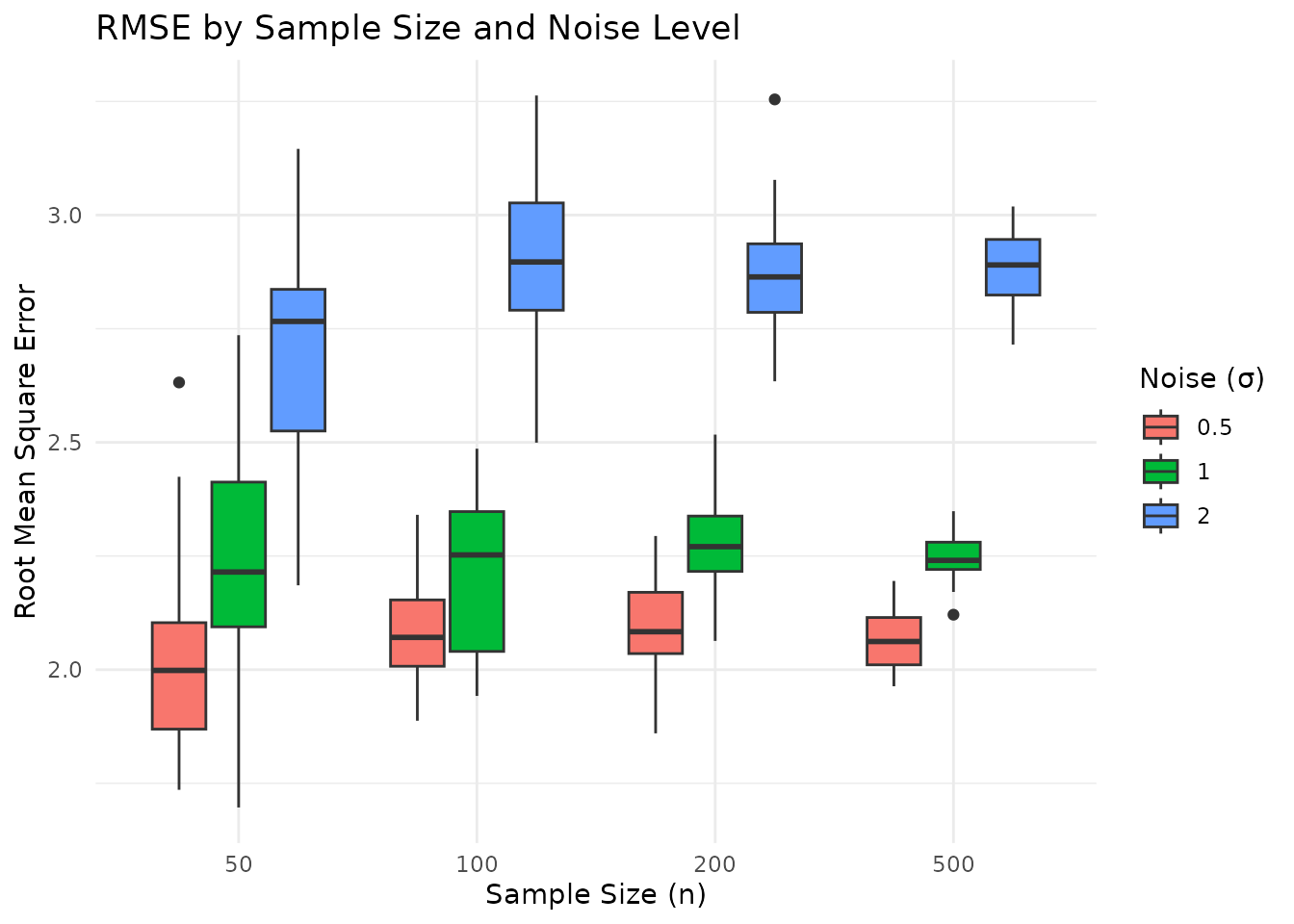
Examine coverage rates:
coverage_summary <- result$summary |>
  group_by(data_n, data_sigma) |>
  summarise(
    coverage_rate = mean(coverage__mean, na.rm = TRUE),
    .groups = "drop"
  )

ggplot(coverage_summary, aes(x = data_n, y = coverage_rate, color = factor(data_sigma))) +
  geom_line(linewidth = 1) +
  geom_point(size = 3) +
  geom_hline(yintercept = 0.95, linetype = "dashed", alpha = 0.5) +
  scale_x_continuous(breaks = c(50, 100, 200, 500)) +
  labs(
    title = "Coverage Rate by Sample Size and Noise Level",
    subtitle = "Dashed line indicates nominal 95% coverage",
    x = "Sample Size (n)",
    y = "Coverage Rate",
    color = "Noise (σ)"
  ) +
  theme_minimal()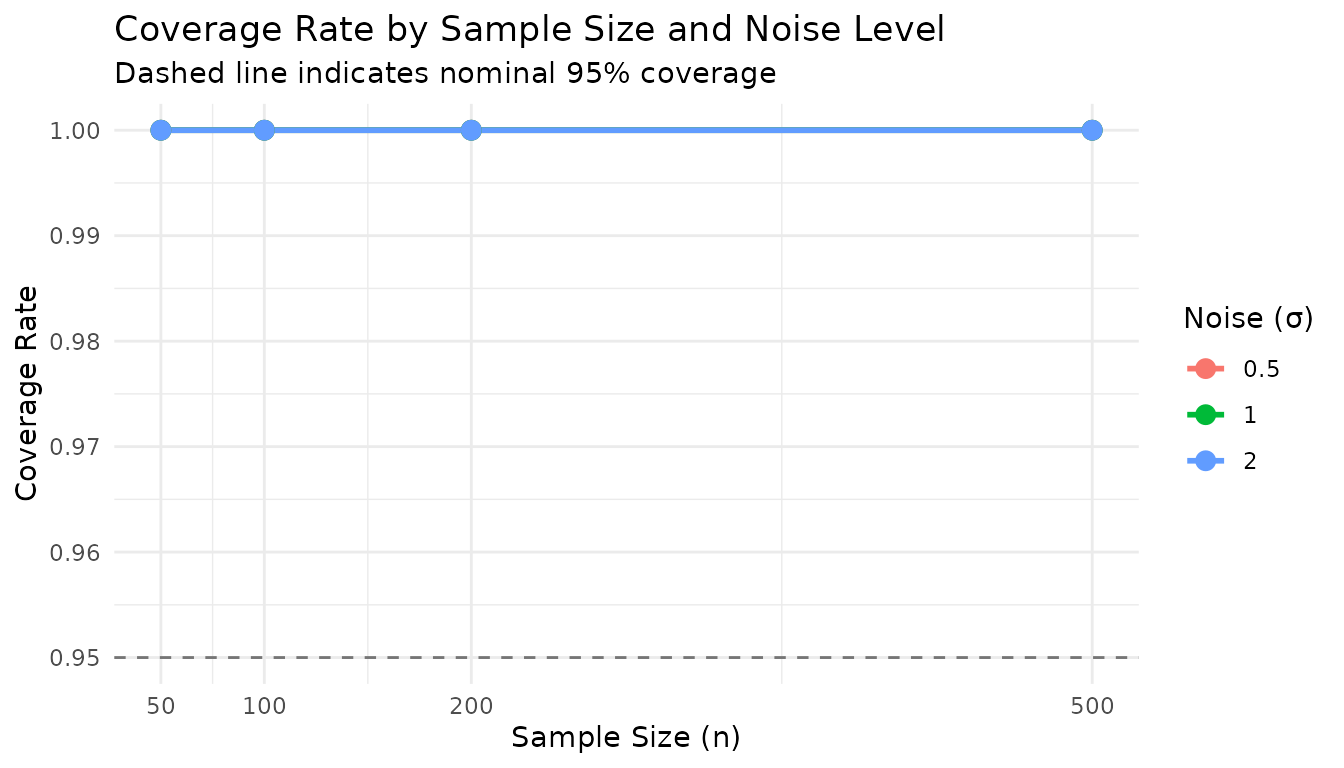
View posterior mean estimates for the slope parameter:
result$summary |>
  ggplot(aes(x = factor(data_n), y = posterior_mean__slope)) +
  geom_boxplot(aes(fill = factor(data_sigma))) +
  geom_hline(yintercept = 2.0, linetype = "dashed", color = "red") +
  labs(
    title = "Posterior Mean Estimates of Slope",
    subtitle = "Red dashed line indicates true value (2.0)",
    x = "Sample Size (n)",
    y = "Estimated Slope",
    fill = "Noise (σ)"
  ) +
  theme_minimal()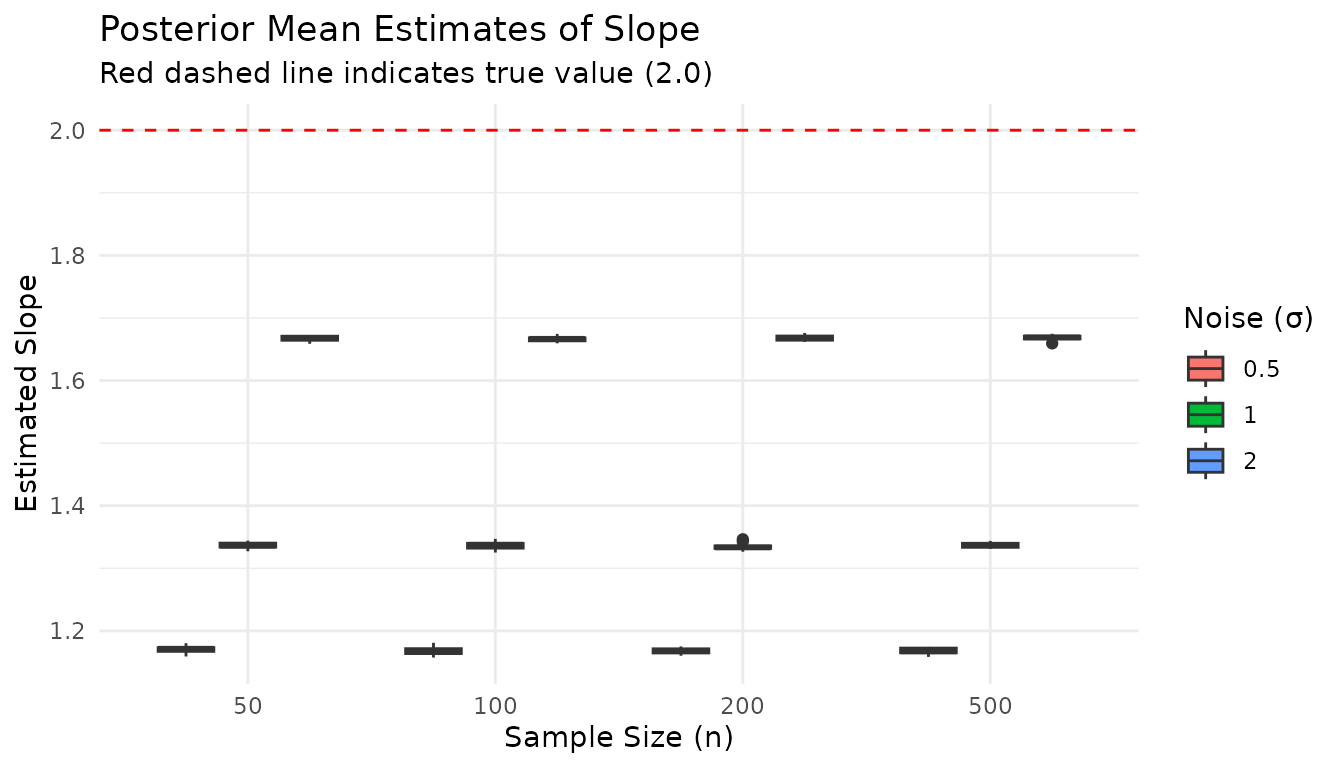
Accessing the Task Grid
The result also contains the task grid, which shows the full experimental design:
head(result$task_grid)
#> # A tibble: 6 × 6
#>   data_idx fit_idx rep_idx task_id          rng_seed  status
#>      <int>   <int>   <int> <chr>            <I<list>> <chr>
#> 1        1       1       1 d001_f001_r00001 <int [7]> success
#> 2        1       1       2 d001_f001_r00002 <int [7]> success
#> 3        1       1       3 d001_f001_r00003 <int [7]> success
#> 4        1       1       4 d001_f001_r00004 <int [7]> success
#> 5        1       1       5 d001_f001_r00005 <int [7]> success
#> 6        1       1       6 d001_f001_r00006 <int [7]> success
This can be useful for custom analyses or for debugging.
Checkpointing
For long-running simulations, enable checkpointing to save progress periodically:
config_with_checkpoint <- simulation_config(
  data_grid = data.frame(n = c(100, 500, 1000)),
  fit_grid = data.frame(model = "complex_model"),
  data_generator = generate_linear_data,
  fitter = MockFitter(),  # Replace with BrmsFitter() for real models
  metrics = list(
    rmse_metric(),
    coverage_metric()
  ),
  n_replicates = 100L,
  seed = 42L,
  result_path = "my_simulation_results",
  checkpoint_every = 50L
)

# Run with resume capability
result <- run_simulation(config_with_checkpoint, resume = "auto")
If the simulation is interrupted, resume from the last checkpoint:
result <- resume_simulation("my_simulation_results")The checkpoint system validates that the configuration matches the
saved state, preventing accidental mismatches between resumed runs and
modified code. The supported checkpoint backend is
checkpoint_format = "rds".
Summary
This vignette demonstrated a complete simulation study workflow:
Defined a data generator that creates synthetic linear regression data with configurable sample size, slope, intercept, and noise level.
Created a simulation configuration specifying the experimental grid, metrics, and execution parameters.
Ran the simulation with progress tracking and obtained reproducible results.
Analyzed results using dplyr aggregation and ggplot2 visualizations to understand how estimation accuracy varies with sample size and noise.
Showed checkpointing for long-running studies that need interruption tolerance.
Key points for conducting your own simulation studies:
- Use
MockFitter()for rapid prototyping and testing; switch toBrmsFitter()or custom fitters for real inference - Structure data generators to return complete data bundles with
true_paramsfor coverage calculations - Pass Metric objects with explicit names to the
metricsparameter - Data grid columns appear in the summary with
data_prefix; fit grid columns withfit_prefix - Leverage dplyr and ggplot2 for flexible result analysis
- Enable checkpointing for studies with many replicates or slow model fitting
For more advanced topics, see the other vignettes:
vignette("custom-fitters") for creating custom model
fitters, vignette("reproducibility") for understanding
determinism guarantees, and vignette("memory-management")
for handling large simulations.